TECHNICAL GUIDANCE
UNDERSTANDING EMISSIONS REPORTS
EXCEEDING EXPECTATIONS
| EMISSIONS TESTING | Reading MOT & gas-analyser results |
01 EMISSIONS TESTING OVERVIEW
When a vehicle displays an Engine Management Light (EML) or catalyst efficiency fault code, an emissions test is often carried out to assess exhaust gas output. Emissions tests use MOT-approved or diagnostic gas analysers to measure exhaust gas composition.
⚠ IMPORTANT
An emissions failure reflects the condition of the overall engine system at the time of testing and does not, on its own, confirm catalytic converter failure.
02 TEST STAGES
An emissions report is typically divided into three stages. Results from each stage must fall within specified limits.
|
Fast Idle Test
Conducted at approximately 2,350–2,650 rpm. Measures CO, HC and Lambda (air–fuel ratio).
|
Second Fast Idle
Performed only if the initial fast idle test fails, to confirm the result.
|
Natural Idle Test
Conducted at approximately 600–800 rpm to confirm emissions remain controlled at idle speed.
|
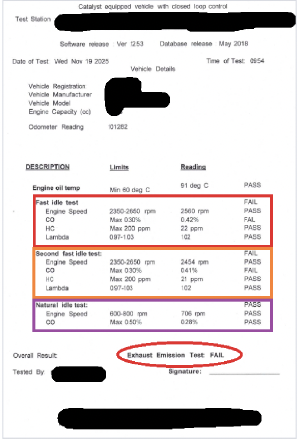
Sample gas-analyser report. Personal and vehicle details have been redacted.
READING THE REPORT
Each report lists the measured limits against the actual readings, with a pass or fail for every line. The three test stages are highlighted below.
Fast idle test — engine speed, CO, HC and Lambda assessed at raised rpm.
Second fast idle test — repeated only where the first stage fails.
Natural idle test — CO confirmed within limits at idle speed.
An overall Exhaust Emission Test result is given at the foot of the report, summarising the pass or fail outcome across all stages.